Look abroad thro' Nature's range.
Nature's mighty law is change. - Robert Burns
Although change artists often work as prime movers, they more often work through understanding natural forces and creating slight perturbations of Nature. In this challenge, you will practice facilitating the change projects of others, using various ways of empowering from the position of catalyst. In chemistry, a catalyst is a substance that added to a reaction accelerates that reaction by its presence, without itself being changed by the reaction.
A human catalyst is someone who rouses the mind or spirits or incites others to activity with a minimum of self-involvement—in other words, by empowering others. For people to be empowered to change their organization, the MOI model tells us that the following ingredients are required:
Motivation
• self-esteem
• a value system and a vision held in common
• a sense of difference between perceived and desired
Organization
• mutuality of support, based on personal uniqueness
• a plan for reducing the perceived-desired difference
• a diversity of resources relevant to the plan
Information
• a systems understanding of what keeps things from changing
• an understanding of empowerment versus powerlessness
• continuing education appropriate to the tasks
Often, only a single ingredient is missing, but the person who doesn't know which one it is can feel completely disempowered. The recipe suggests which ingredient might be missing. A change artist who supplies that missing ingredient can catalyze change with minimal effort.
The Challenge
Your challenge is to facilitate other people's change projects, approximately one per week, for at least two weeks. You should attempt to be a catalyst, for change, not the prime mover for change. To be a catalyst, you should involve yourself
• as effectively as possible
• in the smallest possible way
• without depleting your capacity to catalyze other changes
If possible, use each ingredient of this recipe for empowerment at least once. Keep notes in your journal and be prepared to share learnings with the group you are catalyzing.
Experiences
1. A group in the shipping department asked me to help them run their planning meetings. I said I would do it if they enrolled two people in our facilitation class, and that after taking the class, they would work alongside me. After one meeting, they are now facilitating their own.
2. I led a technical review of the design of a very controversial project, and apparently I did a good job because I got three other invitations to lead difficult reviews. I did lead two of them, but I decided to try being a catalyst on the third. I told them I wouldn't lead the meeting, but I would play shadow to a leader of their choice and we would switch roles if their leader got in trouble. She didn't.
3. One of my groups wasn't using—or even attempting to use—the new configuration control system. Ordinarily, I would have ordered them to use it, with threats of reprisals. I thought about the minimum thing I could do—with no force and no blaming—to get them moving. I decided to call them in for a meeting and give them the problem of how to get them moving. They told me they just didn't have time to switch their partially developed project to the new system. I asked them how much time they would need. They huddled and came up with a two-week extension to their schedule. (I had been afraid they would say two months.) Since they were off the critical path, I said they could have the two weeks, but only if they switched to the new system. They actually did the job in one week, and in the end, they made up four days of that—partly, at least, because of using the better tool. I've now used this consultation method several more times. "What would you need to give me what I need?" turns out to be a great catalyst. I like being a catalyst much more than being a dictator.

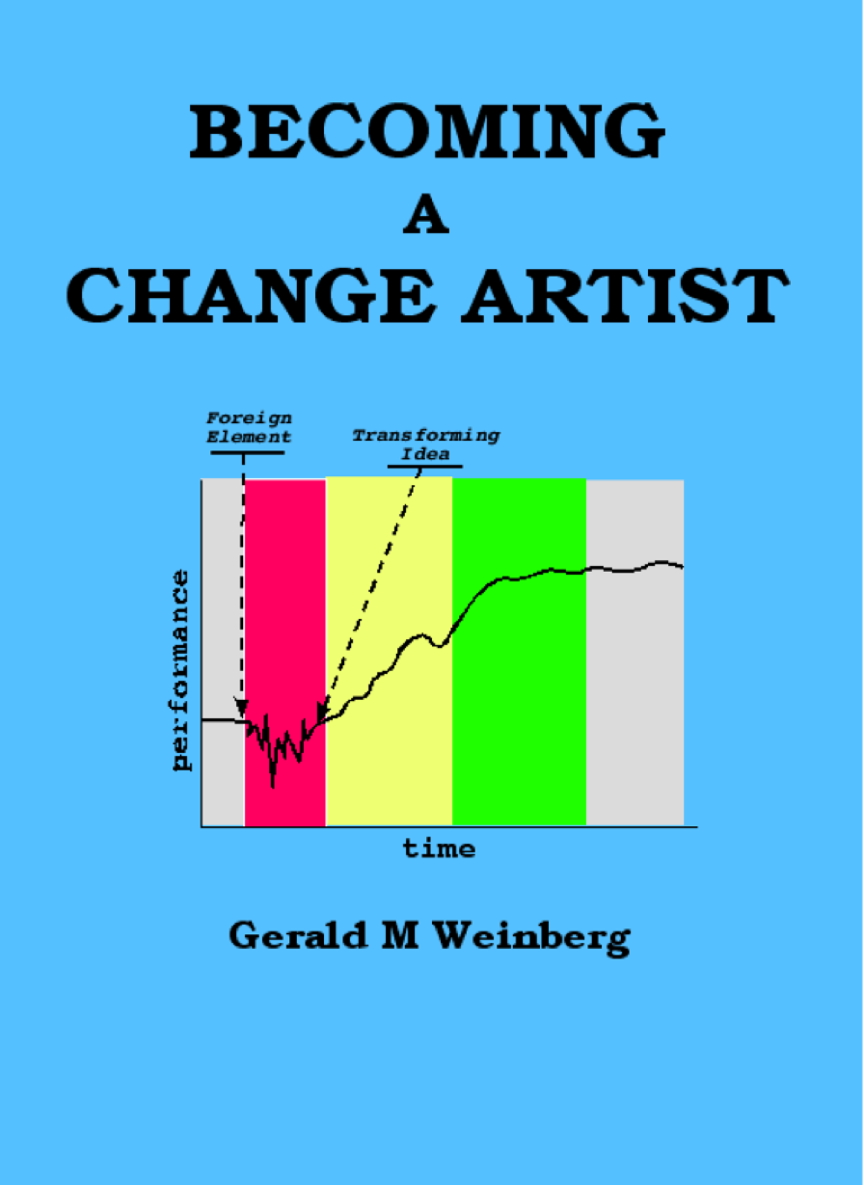
These challenges are adapted from my ebook, Becoming a Change Artist, which can be obtained from most of the popular ebook vendors. See my website <
http://www.geraldmweinberg.com> for links to all of my books at the major vendors.

 So, if you are asking how you, as the underling, can “correct” your boss, I suggest you learn how to offer (not “give”) information. The boss can then decide whether or not to act on this new information, and how to do it.